Why can't I stop doomscrolling? What the research says
Doomscrolling is not a willpower failure. What studies have found about why it starts, why it sticks, and what has actually helped people cut back.
If you have ever looked up from your phone an hour later feeling worse and wondering why you kept going, you are not unusual. Researchers have started to study doomscrolling as its own behavior, and what they found explains a lot about why it is so hard to stop.
It starts as staying informed
A 2022 study from the University of Florida built a scale to measure doomscrolling. As the university summarized it, it tends to start with a reasonable goal: keeping up with bad news. Over time, that goal turns into a habit that keeps going after it stops being useful.
The same study found it was linked to fear of missing out and to being constantly connected through a smartphone. It was more common among younger people and men, and it showed up across the political spectrum.
The feed never ends
Print newspapers end. Evening news ends. A feed does not. There is no natural stopping point, so stopping always takes a decision, and decisions are hardest when you are tired, which is exactly when most people scroll.
Passive scrolling feels worse than it looks
Watching without doing anything seems harmless. But a study of Twitter users found that most of their use was passive, and passive scrolling was the part linked to lower wellbeing. Replying and visiting profiles was linked to a stronger sense of belonging. Doomscrolling is almost entirely passive.
What has actually helped
The best evidence comes from experiments where people were assigned to change their use, not just asked about it.
- Limits: in a 2018 University of Pennsylvania experiment, students who held Facebook, Instagram and Snapchat to about 10 minutes each per day for three weeks reported less loneliness and depression than those who did not. The study was small, 143 students, so treat it as a promising sign rather than proof.
- Breaks: in a large US experiment, people paid to deactivate Facebook for the four weeks before the 2018 midterms reported higher well-being. They also knew less about the news, and they kept using Facebook much less after the experiment ended.
What this means for you
- Do not count on willpower at midnight. Set limits earlier in the day, when you can still decide.
- Give the habit somewhere else to go. A break works better if the time it frees up has a place to land.
- Turn passive into active: save, note or share the one thing that was worth it.
- Keep the news, but get it whole and once, instead of in a hundred pieces.
Where Oho fits
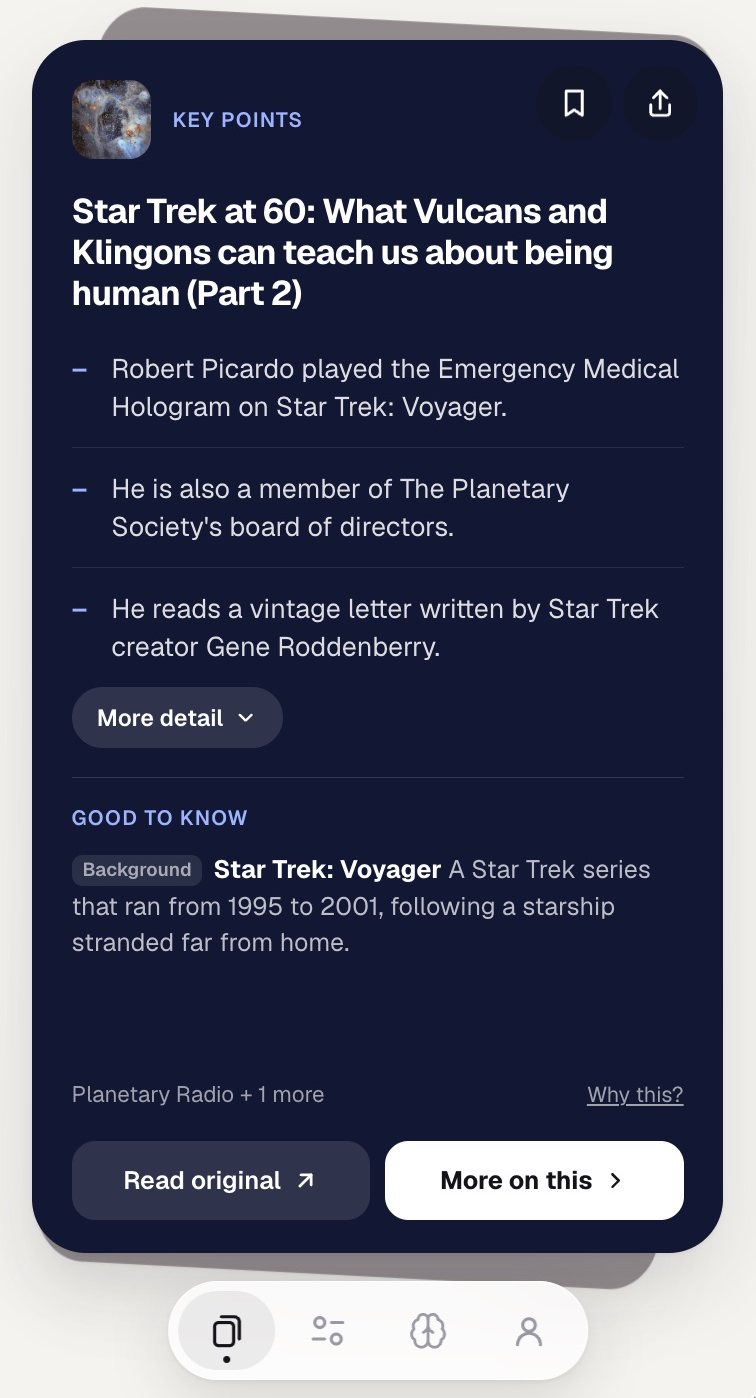
Oho is our attempt at somewhere else for the habit to go. It is a feed of short cards from 1,000+ sources (magazines, research papers, newsletters, lectures and podcasts) on topics you pick. Every card names its source and links to the original, and you can save a card with a line in your own words.